
Climate Action


 e sdg icons 06  e sdg icons 07  e sdg icons 09 e sdg icons 12  e sdg icons 13 

Greenhouse Gas Emissions Reduction Management Policy

The Company recognizes the importance of greenhouse gas emissions management and reduction as part of its commitment to addressing climate change. The Company supports and promotes effective greenhouse gas management practices that create benefits for the organization, society, and the environment. These efforts are aimed at guiding the Company toward a low-carbon society while aligning with international environmental agreements on climate change.

Implementation Strategy


  • Reducing emissions from manufacturing processes
  • Increasing revenue from low-carbon and environmentally friendly packaging
    • Low-carbon packaging to support sustainable development
    • Environmentally friendly packaging to drive business growth
  • Reducing greenhouse gas emissions across the supply chain
  • Implementing systematic waste management
  • Enhancing partnerships and collaboration with communities and society
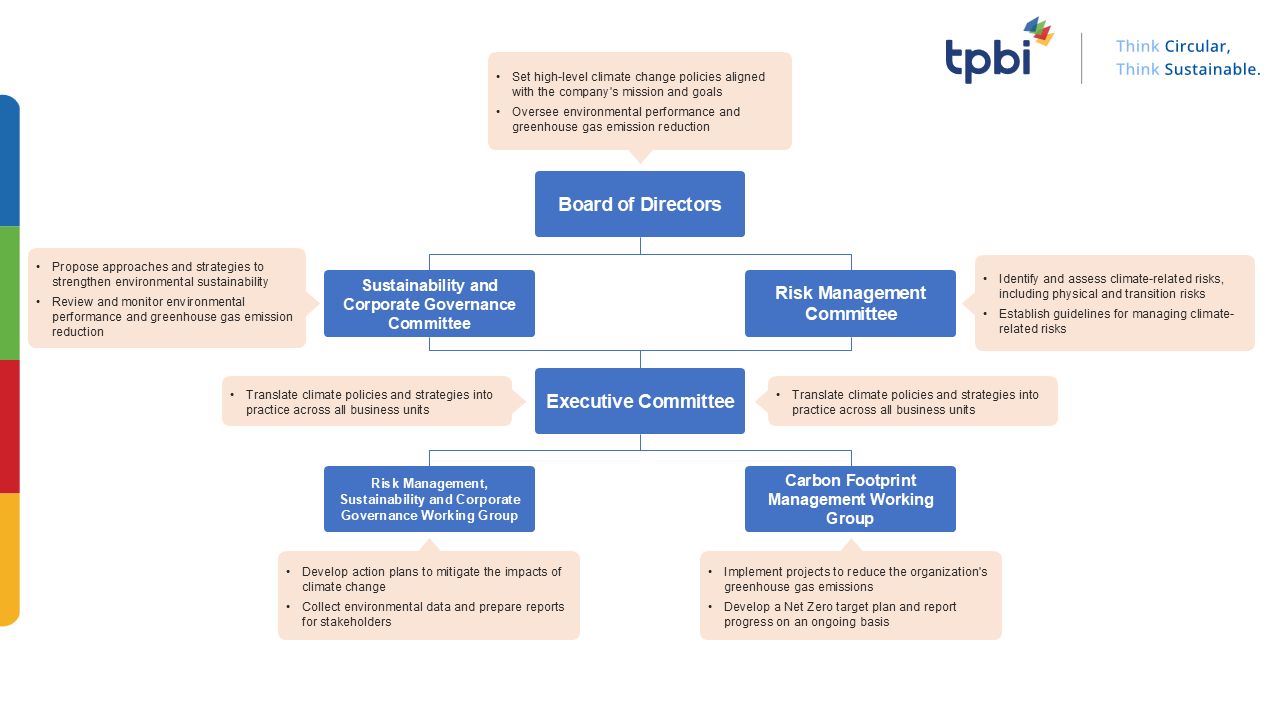
 

Climate Change Management Governance Structure

Climate Change Governance Structure

The Board of Directors and management are committed to reducing greenhouse gas emissions, which are a key contributor to climate change. The Company has established a climate change management strategy that is aligned with the United Nations Sustainable Development Goals (SDGs) and internationally recognized standards, as outlined below:

Policy and Target Review

The Company has reviewed its environmental management policy and greenhouse gas emissions reduction targets. In addition, the Company has revised its Net Zero target to 2050 and developed implementation strategies to ensure alignment with the updated target.

Production Process Development and Innovation

The Company has adopted Artificial Intelligence (AI) technology through the SIGMA AIR MANAGER (SAM 4.0) system to manage its compressed air system, enhancing energy efficiency and reducing greenhouse gas emissions. Furthermore, the Company has transitioned from chemical-based inks to water-based inks in order to minimize environmental impacts.

Renewable Energy Utilization

The Company generated a total of 3,563,895 kWh of electricity from its solar rooftop systems, accounting for 9.8% of total electricity consumption. The solar panels are regularly maintained to ensure optimal performance and efficiency in electricity generation.

Energy Efficiency Improvement

The Company continuously improves and maintains its machinery and equipment to enhance operational efficiency. Electricity consumption is closely monitored, and energy conservation campaigns are promoted across all departments to encourage efficient energy use throughout the organization.

Behavioral Change and Environmentally Friendly Initiatives

The Company has implemented initiatives aimed at promoting behavioral change within its offices to reduce energy consumption. These initiatives also focus on waste reduction through the principles of Reduce, Reuse, and Recycle (3Rs), minimizing and eliminating the use of hazardous chemicals, and promoting the procurement of environmentally friendly products and services through Green Procurement practices.

Product Carbon Footprint Assessment

The Company has conducted Carbon Footprint of Product (CFP) assessments for 15 products to evaluate and reduce greenhouse gas emissions throughout the product life cycle. This initiative supports the Company's efforts to improve environmental performance and develop more sustainable products.

Certification and Verification

The Company has prepared its greenhouse gas emissions data in accordance with international standards. Emissions data for 2021-2024 have been verified by SGS (Thailand) Limited, a verification body registered with the Thailand Greenhouse Gas Management Organization (TGO).

For 2025, the Company is in the process of preparing and reporting its greenhouse gas data in accordance with ISO 14064-1, with completion expected by mid-2026. Implementing the ISO 14064-1 standard will further enhance the credibility, transparency, and reliability of the Company's greenhouse gas management practices in alignment with internationally recognized standards.


Key Performance Indicators (KPIs)

Membership of Business Associations and Climate Positions

The Company is a member of the Thai Listed Companies Association (TLCA), the Federation of Thai Industries (FTI), and the Thai Plastic Industries Association. The FTI supports the transition of Thai industry towards Net Zero through its Climate Change Institute (FTI-CCI), which promotes greenhouse gas reduction, knowledge sharing, and climate action among member companies. The TLCA supports listed companies in preparing for climate-related disclosures under the IFRS S1 and IFRS S2 sustainability disclosure standards through training programs. The Thai Plastic Industries Association, together with the Plastics Industry Club of the FTI, promotes circular economy principles across the plastic value chain to support the transition towards a low-carbon economy. These positions are consistent with the Company's Net Zero target by 2050, which is aligned with Thailand's national goals and the Paris Agreement. The Company also served as Chairman of the Organizing Committee for A-PLAS 2024, held under the theme "Integrating Plastic Value Chain for Eco-Future" to drive the transition towards a carbon-neutral world.


Position on Climate-related Public Policy

The Company supports Thailand's climate policies under the Paris Agreement, including Thailand's Nationally Determined Contribution (NDC) and Long-Term Low Greenhouse Gas Emission Development Strategy (LT-LEDS), which set national targets of carbon neutrality by 2050 and net zero greenhouse gas emissions by 2065. The Company supports these policies through the following voluntary actions:

  • Setting a Net Zero target by 2050, ahead of Thailand's national net zero target of 2065.
  • Supporting the Thai Parliament's "Green Parliament Declaration: Towards Net Zero by 2032" and its Green Parliament Master Plan 2025–2032 in September 2024, represented by the Chairman of the Executive Committee, and showcasing the Company's circular economy and plastic waste management initiatives, including the WON Project, which align with the Parliament's net zero goal.
  • Voluntarily participating in the Carbon Footprint for Organization (CFO) program of the Thailand Greenhouse Gas Management Organization (TGO), with greenhouse gas emissions data for 2021–2024 verified by a TGO-registered verifier and certified by TGO.
  • Voluntarily assessing the Carbon Footprint of Product (CFP) for 15 products and applying for TGO's Carbon Footprint Reduction (CFR) labels.
  • Joining the Thailand Carbon Neutral Network – Climate Action Leaders Organization (TCNN-CALO) under TGO.
  • Participating in the Ministry of Industry's Green Industry program, achieving Green Industry Level 4 (Green Culture).
  • Supporting the Bangkok Metropolitan Administration's revised waste collection fee regulation ("the more you sort, the less you pay") as a partner in the Pilot Household Waste Separation Program in Bangkok Condominiums in 2026, through the WON Project's plastic recycling expertise.

Climate-related Risk Assessment Process

Climate-related risks are identified and assessed annually by the Risk Management, Sustainability and Corporate Governance Working Group as part of the Company's enterprise risk management process, and reviewed by the Risk Management Committee. Risks are classified into transition risks (such as greenhouse gas regulations, carbon pricing, and customer requirements including the EU Carbon Border Adjustment Mechanism) and physical risks (such as water stress, drought, and flooding, assessed using the WRI Aqueduct Water Risk Atlas). Each risk is assessed by likelihood and impact on operations, costs, and revenue, and risks rated as significant are included in the corporate risk register with mitigation measures, responsible owners, and monitoring indicators, which are reported to the Risk Management Committee and the Board of Directors.

Integrating Climate-related Risks and Opportunities into Business Strategy

  1. Transition risk
    Carbon regulations and customer decarbonization requirements: Stricter greenhouse gas regulations in customer countries, such as the EU Carbon Border Adjustment Mechanism (CBAM), and customers' requirements for lower-carbon packaging may increase compliance costs and affect the Company's competitiveness in export markets, which account for over half of revenue. Strategy: The Company reduces emissions from its manufacturing processes through renewable energy (solar rooftop generation of 9.8% of total electricity in 2025), AI-based compressed air management (SIGMA AIR MANAGER 4.0), and the transition to water-based inks, and has assessed the Carbon Footprint of Product (CFP) for 15 products to provide verified carbon data to customers and apply for Carbon Footprint Reduction (CFR) labels.
  2. Market opportunity
    Growing demand for low-carbon packaging: The shift in customer and consumer demand toward low-carbon and environmentally friendly packaging creates opportunities to increase revenue. Strategy: The Company's research and development focuses on increasing recycled content and developing lower-carbon products, including Bio-Based Polyethylene (Bio-PE) packaging made from sugarcane-based renewable resources that reduces CO2 emissions throughout the product life cycle, Post-Consumer Recycled (PCR) packaging and resin with 30–100% recycled content certified to the Global Recycled Standard (GRS), and Design for Recycling (D4R) through down-gauging and mono-material solutions. Green products currently account for over 20% of sales, with a target of 30% of the product portfolio.
  3. Physical risk
    Water stress, drought, and flooding: Both of the Company's manufacturing sites are located in water-stressed areas, which may affect water supply and business continuity. Strategy: The Company monitors water consumption per ton of output against annual targets, implements water efficiency measures, and maintains business continuity plans for its key operations.